For some time now, major reports such as the UN Global Risk Report or the IPCC’s Sixth Assessment Report (2022) have sounded alarm bells on the risk of mis- and disinformation for slowing down climate action. With COP30’s renewed focus on the fight against environmental disinformation, addressing information integrity is becoming increasingly a priority in the international policy arena.
In this podcast episode, we wish to address how mis- and disinformation are embedded into wider anti-science narratives and how to combat them effectively. How does disinformation spread, who is behind it? Who is most vulnerable to believe misinformation, and what strategies can help counter it?
The mechanisms that sustain disinformation
Sustainability science is one of the main targets of mis- and disinformation, and vice-versa, mis- and disinformation is a core challenge for sustainability science. With disinformation often being the product of a strategic interest on the part of certain actors, it is important to ask the question of who benefits, economically and politically, from climate disinformation campaigns. This leads us to a first essential question: what are the mechanisms and actors by which disinformation operates and what threat does it pose to environmental action?
A psychological perspective on disinformation
Disinformation however, is not only a question of faulty sources or “fake news”. Psychological biases and predispositions impact the way we process information generally, and news about environmental change more specifically. In a world where mis- and disinformation are widespread, it is important to understand what biases lead people to accept these messages as true. Hence, a second question we would like to address is how does the systemic dimension of disinformation interplay with the psychological factors that render people more vulnerable to believing fake news? How can a psychological perspective help us gain a more complete picture of mis- and disinformation and how to address it?
This podcast is an opportunity to learn more about what strategies and initiatives have been developed to counter mis- and disinformation, and to reflect on how the current information crisis challenges what we know about the relationship between science and society.
Speakers
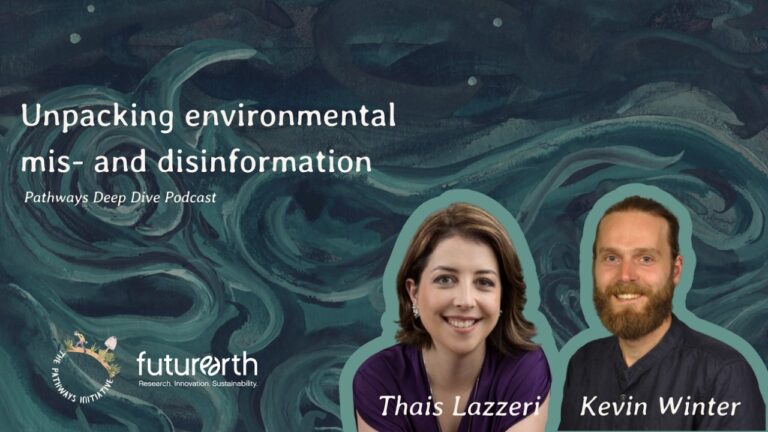
Thais Lazzeri – founder and director of FALA – Estúdio de Impacto. A journalist and researcher, she created Mentira Tem Preço (“Lies Have a Price”), an initiative exposing the true economic and social costs of climate disinformation and its supply chains. She also directs the Observatory for Information Integrity on Climate (Oii-Observatory).
Kevin Winter – postdoctoral researcher at the University of Hohenheim, Germany. As a social psychologist, his work focuses on why people come to believe misinformation and what strategies can be used to make people less vulnerable to fake news.
Listen to our podcast
Listen to our podcast on streaming platforms and on YouTube.
Want to go further? Find here our reading list on environmental disinformation.
To receive monthly updates on information integrity and the climate agenda, subscribe to the Observatory for Information Integrity on Climate (Oii-Observatory) newsletter.