The Pathways Deep Dive is back with a new seminar series “Technology and Habitability” co-developed with the Center for Earth Politics, Paris Cité University.
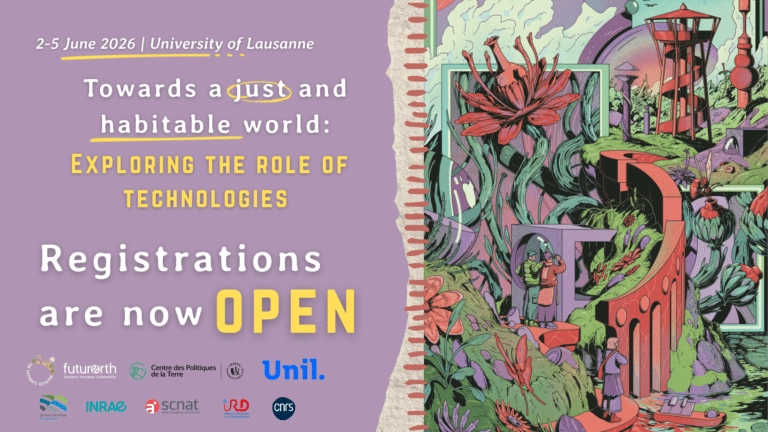
In continuity with the theme of our 2026 European conference “Towards a just and habitable world: exploring the role of technology” organized together with the Center for Earth Politics and the University of Lausanne, this seminar series furthers the discussions on the co-evolution of technological and socio-ecological systems.
It will ask how technological systems can transform societies and our territories, and how they are themselves transformed by societal, political and ecological dynamics. The seminars will cover many different research themes such as geoengineering, biotechnologies, AI, low-tech approaches or agroecology. In this way, the series seeks to understand how the co-evolution of technological and socio-ecological systems can reconfigure the habitability of our Earth and what kind of relationships to technologies, our environments and the living world they give rise to.
Session 1 - Life Technologies : Ethical, Societal and Political Impacts
When? 12 November 2026, 10:00–12:30 CET, online
This opening session for the Technology and Habitability seminar series will feature the MICROB’EX inIdEx project team as the main guests.
The discussion will be centered around the broad theme of biotechnologies, or “life science technologies”, focusing on technological developments that are transforming the ways in which we observe, understand and interact with living systems.
We will specifically focus on the contributions of microbiology and how living organisms, including microorganisms and sentinel organisms, can inform us about the state of our environment and our health. We will also address how these biotechnological systems might shape research practices, health and environmental monitoring, as well as our relationships with living organisms and their environments.
Finally, we will explore several points of connection between our different research perspectives: How do new technologies transform our ways of producing knowledge about living systems? What new possibilities do they open for monitoring environmental and health conditions, notably through sentinel organisms ? How can we understand the opportunities and challenges associated with intervening in living systems?
Beyond this scientific scope, the session will also consider how life technologies may transform our societies, our relationships with the living world and our interactions within the nature–culture complex. How might these socio-technological transformations affect the ways we perceive, imagine and understand living organisms, health and environments? How are new practices and technologies received, accepted or contested by stakeholders and the widerpublic? And finally, what ethical, societal and political questions may arise as these technologies become increasingly present in research, healthcare, environmental management and everyday life?
This session will take the form of an open roundtable discussion with:
- Claas Kirchhelle : Historian, Inserm, CERMES3 — Claas Kirchhelle is a historian of science, technology, medicine and the environment at CERMES3 (Inserm). His research focuses on the history of microbial environments, disease control, antibiotic and vaccine innovation and regulation. His work also explores the biopolitics of « sentinel organisms » and their role in environmental health.
- Olivier Tenaillon : Inserm Research Director, Institut Cochin — Olivier Tenaillon is the director of MICROB’EX as well as an Inserm Research Director at Institut Cochin, where he leads the Quantitative Evolutionary, Ecological and Mechanistic Microbiology team. His research focuses on microbial evolution and adaptation, particularly in Escherichia coli, combining experimental evolution, genomics, mathematical modelling and molecular genetics to study bacterial adaptation and antibiotic resistance.
The discussion will be moderated by the leads of Research Axis 3 of the Center for Earth Politics, which focuses on the study of the exposome:
- Xavier Coumoul : Professor, Université Paris Cité; Director, Inserm Health & Functional Exposomics (HealthFex) — Xavier Coumoul is Professor of Biochemistry and Toxicology at Université Paris Cité and Director of the Inserm Health & Functional Exposomics (HealthFex) unit. His research focuses on the mechanisms of action of environmental contaminants and on the exposome and its implications for human health.
- Céline Cruciani-Guglielmacci : Professor of Animal Physiology, Université Paris Cité — Céline Cruciani-Guglielmacci is Professor of Animal Physiology at Université Paris Cité and a member of the CNRS/Université Paris Cité BFA research unit. Her research focuses on physiological and neurobiological mechanisms involved in energy homeostasis, including the role of the brain in the regulation of metabolism.