Off-radar : arranging humans’ place within Senegalese Blue lands
- a blog associated with the Programme Ajalala
“Pull this net and I shall feel your strength!
It is thanks to the encircling net that I earn my living.
It is here that I have grown up.
It is here that I have been educated.
It is here that I have learnt everything.
I did not go to school and I have not learnt Arabic.
It is here that I do my prayers.
It is here that I continue earning my living.”
(An excerpt from a song sung by fishermen, lyrics translated from local language)
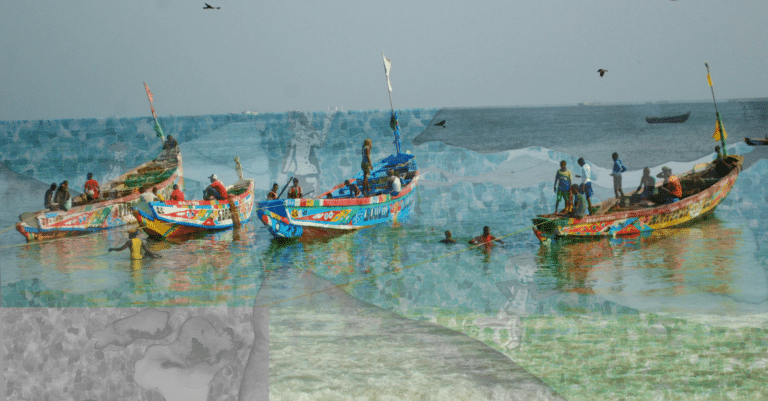
As “Golden fish, African fish” takes us on a pirogue, collective chants captured by Directors Thomas Grand and Moussa Diop inspirit fishermen’ unwavering dedication to this mission. With the unfolding lyrics, the encircling net fishing technique that takes place gives a sense of what fishing represents. Fishing time’s up in Casamance ! A mass of fish boxes flows from the crowded beach and swarms the numerous boats to get filled up. Once again briskly expelled, the journey through the transregional supply and value chain is yet to begin. Amid the rush, performers recount their experience and connection to senegalese sardinella (yaboye); but underlying tensions appear in the wings as discourses progressively shed light on the lingering wariness towards Chinese emerging fish factories.
“The profession of fisherman is the noblest, because it is the fishermen who form the foundation of the entire port economy.”
(A local fisherman, translated from local language)
On April 17, 2025, BP exported its first LNG shipment from offshore resources shared by Senegal and Mauritania, about 10 years after the gas and oil reserves were first discovered, and one year after first offshore oil-production. That day, Senegal officially entered its Oil and Gas era. Meanwhile, for some years now, actions toward the development of a marine spatial planning (MSP) for Senegal have been conducted. A plan is currently being drawn up. This guiding document will affect about 212 000 km² of territorial sea, 23 800 km² of continental shelf and 718 km of coastline, but also the 17,400 pirogues that are estimated to constitute the country’s artisanal fleet. The plan must manage links with maritime heritage conservation and the Kunming-Montreal Global Biodiversity Framework, the Paris agreement, and sustainable blue development through efficient management of maritime activities.
A more fundamental question remains how to address potential conflicts with economic, social, and cultural rights and the ability of people to benefit from resources. Likewise, the Ministry of Fisheries, Maritime, and Port Infrastructure envisions an economic growth model for the sector driven by sustainability and innovation. Oil, gas, fishery, aquaculture but also tourism, the blue land is essential to national economic competitiveness and global aspirations. Yet, a shift in how sovereignty, justice and prosperity (goals stated in Sénégal 2050 National Agenda for Transformation) are perceived may be needed, before any progress toward a MSP that embodies grassroots perspectives and responds to local conditions can be made. Indeed, this sector-wide crisis affects about 50,000 fishers and nearly 20% of the country’s active population which indirectly relies on fishery.
“Here, they don’t consider human beings; they only consider their fish. (…)
“Before considering money or fish, people must be considered.”
(A male fish box carrier, translated from local language)
The documentary was shot between 2016 and 2017. It depicted an economically vibrant and multicultural Kafountine village, connected to the west African sub-region through smoked sardinella and new waves of migrants. The picture now would be quite different. Catching the crucial pelagic poses a major challenge in the area, slowing down the bustling flow of money and affecting the making of traditional dishes. At Ouakam local market, in Dakar, small sardinella prices hit 250 CFAF (2025). Watching the documentary, the shift may appear out of the blue; but the combined fishing pressure of industrial and artisanal fleets on resources is a lasting issue. Illegal unreported unregulated fishing in the Senegalese waters has increased over the past two decades. The tropicalisation of ecosystems also redistributes sardinella and other small pelagic fish populations, as stocks migrate north.
With current poor catch levels, it’s becoming difficult for fishers to meet daily expenses, not to mention savings and access to the banking system. Fishing no longer acts as a safety‐net that prevents impoverishment. While the sector has been subsidized by the state since the 1960s, more support is long overdue, especially since current job opportunities make transitioning to other economic positions beyond reach. Pirogues keep spending longer periods heading away into the high seas in search of this golden fish, and at greater cost; but for the surging number of the disillusioned determined to migrate to Europe at all hazards, the Canaries represent the royal road to seek fortune : “Barça wala Barsakh” [Barcelona or death], a well-known Wolof leitmotiv for these youth generations who take the plunge before sinking, in search of more definitive and uncharted new beginnings – a 1,500 km path, flirting with ancestors. Mobility and adaptation are somehow long-term markers of fishing communities.
“Everything that happens to us is due to them.
The trawlers which threaten us.
It is because of them that we have to go fishing further and further away.
This is why we, the fishers, are protesting.
These boats need to be driven away, far far away into the high seas.”
(An excerpt from a song sung by fishermen, lyrics translated from local language)
About fishing migration per se, the growing activity of migratory fishers remains insufficiently monitored and integrated within the marine conservation processes and the national and regional fisheries management of countries from where migrants originate and from where catches occur as well. How to formalise the place of fishing communities where part of the fishers and their movement patterns constantly strategically change, from Mauritania to Sierra Leone, depending on sea opportunities but also age? How to take into account, for instance, the strained relations between local and migrant populations resulting from the destabilizing and restructuring impacts on local communities of foreigners’ presence? The days of gentlemen’s agreements with the village chief are past, but institutional arrangements don’t appear to have found the right way to supplement them. As early as the late 1970s, the progressive establishment of Exclusive Economic Zones within the framework of the third United Nations Conference on the Law of the Sea participated in encroaching on West-African artisanal fishing. Again, the creation of the Saint-Louis marine protection area in 2004 following the opening of the breach in the Langue de Barbarie upset local communities.
The mounting pressure toward a critical ecological threshold is an evident reality. Senegal’s high sensitivity to climate change is another challenge. With floods, sea encroachment, and coastal erosion, but also projected habitable land loss induced by rising sea levels, compounded by storm surges, migration patterns are set to reverse, with a shift away from historic coastal attraction toward the hinterland and potential secondary migrations. If Senegal’s case was not already concerning, estimates suggest a cumulative loss between 2020 and 2050 of 68 billion CFAF, due to the anticipated overall drop in the level of catches and their estimated commercial value. Although there is appreciable research on senegalese fishing communities, resource depletion and on the justice dimension, in particular from the perspectives of ecological colonialism and right to food, the local layer-cake blending a profusion of actors, nationalities and elusive activities may benefit fishers who conspicuously stand at the frontline of the fishing economy.
“If your husband has nothing, at least you come working here
and can go back to your country.
Many earn money here and send it to their family in their country of origin.”
(A female storekeeper, translated from local language)
Ndickou Gaye is a senegalese geographer who studies fishing communities, planning processes and gender inequity. Her research work draws attention to the devaluation and erasure of women’s knowledge and contributions to artisanal fisheries, the enhanced vulnerability of women in coastal communities, and thus, the importance of apprehending their specific experience of declining employment and subsistence crisis. In the conventional gendered division of roles, women often process and sell the fish that men catch, and engage in oyster farming. Hence, where local men find an upside in the strong demand for fish products whenever they secure it before wasteful large fleets, local women are compelled to enter the global economy and battle against the voracious aquaculture feed industry. Still, even when fishmongers do succeed in safeguarding this staple food in the domestic market, preventing its redirection toward farmed fish destined for Global North consumers, this once secondary add-on and potential gift has already turned into a prized commodity, only affordable for the nutritional needs of the wealthier local clientele, such as in this Ouakam local market.
Get up and let’s take to the sea !
I shall take to the sea
Get up and let’s take to the sea !
You are going to take to the sea
Get up and let’s take to the sea !
No wealth can keep me away from the sea.
(translated from local language)

References
Photo by Cheikh Tidiane Ndiaye on Unsplash (edited)
All citations are taken from:
Grand T., Diop M. (Réalisateurs). (2007). Poisson d’or, poisson africain
[Film documentaire]. Zideoprod.
This blog was written by Aurélie Mpaka. The idea comes from a presentation made by Ndickou Gaye (Cheikh Anta Diop University, Senegal) as part of the Programme Ajalala. We were very pleased to learn more about her research on Marine Spatial Planning and senegalese fishing communities through her participation.
One handbook of interest on Marine spatial planning in the tropical Atlantic
The Programme Ajalala offers semi-structured training that seeks to strengthen skills for transformative sustainability science and knowledge exchange across world regions.
Learn more about the Programme Ajalala
Find other blogs about some of the online sessions here !