Anna Tsing and the Feral Atlas
When dealing with various environmental challenges, it is easy to be blinded by disciplinary perspectives that obscure the complete picture and hence provide incomplete answers. Even more so when various environmental challenges intertwine across scales and time, as is the case when we talk about the Anthropocene. Although refuted as a geological epoch, the Anthropocene still holds the power to designate the overall state of the world in which humans are the main contributors to environmental change. Having said that, the complexity of this state makes it difficult to apprehend. To understand and deal with the Anthropocene, Anna Tsing proposes to investigate what she calls feral effects.
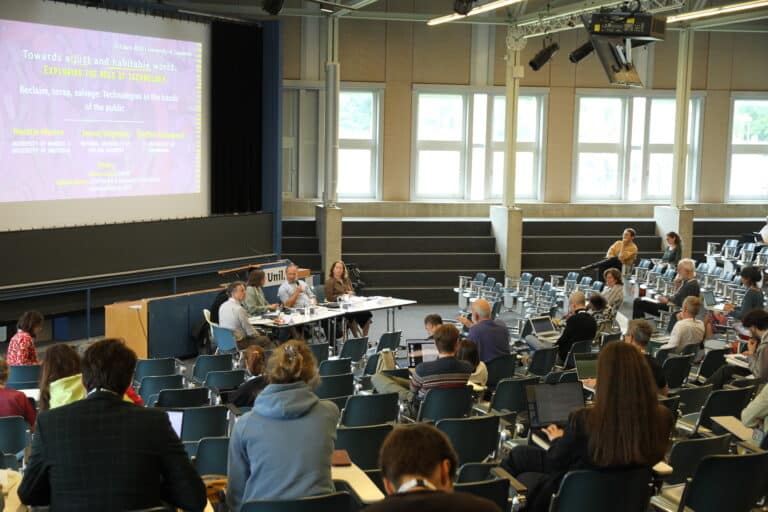
In her talk, Ana Tsing walks us through the Feral Atlas and the subsequent collaborative book Field guide to the patchy Anthropocene. In it, she describes feral effects as the non-designed features of human actions. She describes them as born in human arrangements but outside the control of human engineering. The Anthropocene, she argues, emerges from the feral effects of infrastructure.
Recasting green algae pollution as feral effects
A recent court decision in France may help us to shed some light on what such feral effects may be. On June 24th, 2025, the French State was condemned to compensate Jean-René Auffray’s family after he was found dead on a patch of green algae on a beach of the Atlantic coast (Falc’hon, 2025). The man had been running on the beach and died from hydrogen sulfide intoxication, released by the decomposition of green algae. The case has gained a lot of attention, because for the first time, a direct causality between a human death and green algae was recognized.
Green algae are naturally present on Britanny’s shores. In small quantities, the toxin they release through decomposition can go unnoticed. But since the 1970s, the amount of green algae on the region’s beaches has skyrocketed and is becoming a testimony of the Anthropocene.
How so? Green algae proliferate when three conditions apply: closed and shallow bays, sunny and mild weather, and the presence of large amounts of nitrates in the water. The latter, however, has drastically increased in the past 60 years, going from 5mg/litre in the 1960s to 33mg/litre today. 94% of nitrates can be traced back to agriculture, as they are present both in fertilizers and animal dejections (d’Allens, 2019). Through runoff into rivers and watersheds, nitrates end up in the sea and create favorable conditions for the proliferation of green algae on the shores and the subsequent release of hydrogen sulfide in deadly quantities.
Analysing feral effects in their embeddedness
Just sticking to enumerating a list of feral effects may not be sufficient to gain an analytical understanding of the Anthropocene. Anna Tsing proposes what she calls patch dynamics, or the process through which infrastructure creates patches of feral effects. Green algae for example proliferate in many of Britanny’s beaches and the phenomenon is starting to extend up to Normandy and down to Gironde, creating patches. Another step is analyzing this cascade of feral effects and identify where and under what conditions they arise or what happens to patches when they are embedded into broader planetary dynamics. This connection of patches to the broader Anthropocene, she calls patch-to-planet dynamics.
In her talk, Anna Tsing embarks us on a journey through the many different stories that are being told in the Feral Atlas, hopefully providing us with a new perspective on the Anthropocene, one that extends the purely geological definition to apprehend the totality of our environmental embeddedness.
Sources
Falc’hon, K. (2025, June 25th). Algues vertes et mort d’un joggeur : le « lien direct » est reconnu. Reporterre.https://reporterre.net/Algues-vertes-et-mort-d-un-joggeur-le-lien-direct-est-reconnu
d’Allens, G. (2019, September 14th). Algues vertes en Bretagne: 4 points pour comprendre le problème. Reporterre. https://reporterre.net/Algues-vertes-en-Bretagne-4-points-pour-comprendre-le-probleme#:~:text=Les%20algues%20vertes%20y%20ont,même%20dû%20fermer%20en%20urgence.
Tsing, A. (2025) Wonder In the Midst of Dread. [Conference Presentation]. Rencontres 2025 Les savoirs dans la tourmente : sciences de la durabilité et tensions socio- et géopolitiques. Nantes, France. https://pathways.futureearth.org/videos/rencontres-2025-anna-tsing-wonder-in-the-midst-of-dread/